JEE Study Buddy
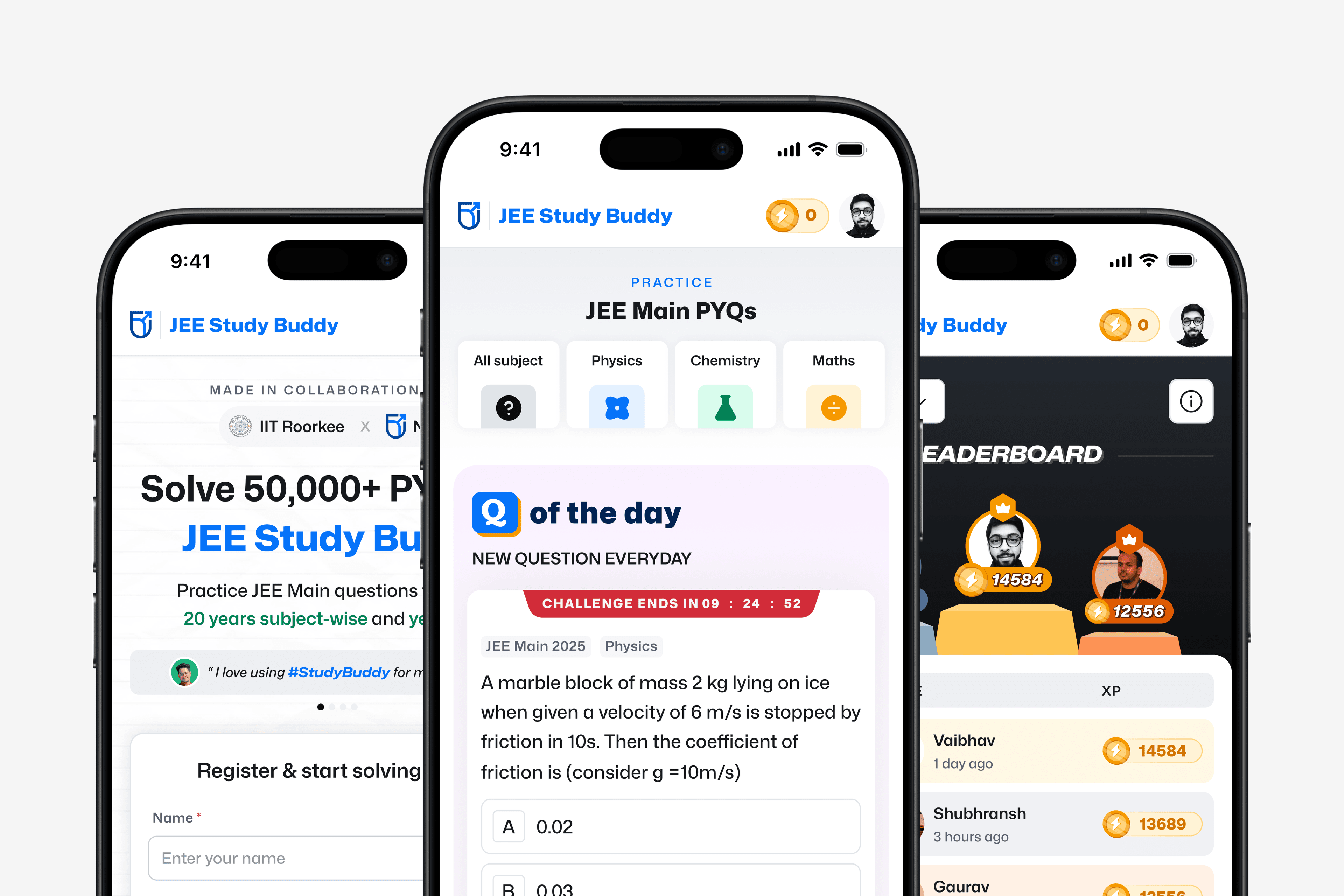
A retention-first gamified platform to practice JEE Main PYQs
How did it all start?
Imagine your 17-year-old cousin preparing for JEE in a Kota hostel. It’s 1 AM, they are stuck on a physics question. Their friends aren’t available as they’re buried in their own preparation. The teacher’s doubt group is silent. Telegram messages pile up, but no one really replies.
Going deeper
To go deeper, our PM team visited Kota for student research in Nov’24. The visit wasn’t just about research. It was a part of our larger business strategy to build growth products around experiences that could both create brand awareness for Newton School of Technology (NST) and unlock new channels for lead acquisition.
Our primary metrics to build growth products were retention and engagement.
What we observed?
We talked to dozens of students in hostels, outside coaching gates, even in between classes We observed a pattern. Online/self-study students were constantly hit by FOMO, wondering how others were preparing, yet having no friends or mentors to discuss doubts with. Offline coaching students had access to teachers but still carried unresolved doubts, nearly half of them because teachers weren’t always available, and online resources were limited. Across both groups, the pattern was clear: everyone was preparing, but no one was preparing together.
Our initial solution
Naturally, our first instinct was, let’s connect students with each other. If someone is weak in Physics (say), match them with someone strong in Physics. We decided to build a matchmaking platform for students.
That’s the where the name JEE Study Buddy came from.
We had to pivot
Then reality hit us. Building a matchmaking platform is almost like building a social network. And we didn’t have that kind of time, design was 2 weeks and so was the development time. Our tech lead, Gaurav Kapatia, raised a valid point: what if students start abusing, sharing numbers, or move the whole thing to WhatsApp? That would kill engagement and create moderation and legal issues. We’d seen this movie before. Our founders had to pivot from a similar product (Bolo) back in Aug’19 for the same reasons. So we decided to pivot early.
The pivoted solution
We started brainstorming again. We found out students value previous year questions(PYQs) a lot. It’s like a goldmine in their preparation. We looked at various platforms out there which offers PYQs either in PDF format or exam format for the students to solve. All of them looked and functioned almost the same. Because we were building for growth and brand awareness, we needed to build something different. What if we gamify the experience of solving PYQs and tell them where they stand on All India level?
Leveraging Octalysis
Around the same time, I was reading Octalysis, a gamification framework. One of the core drives is Unpredictability & Curiosity, you keep engaging because you don’t know what’s coming next.
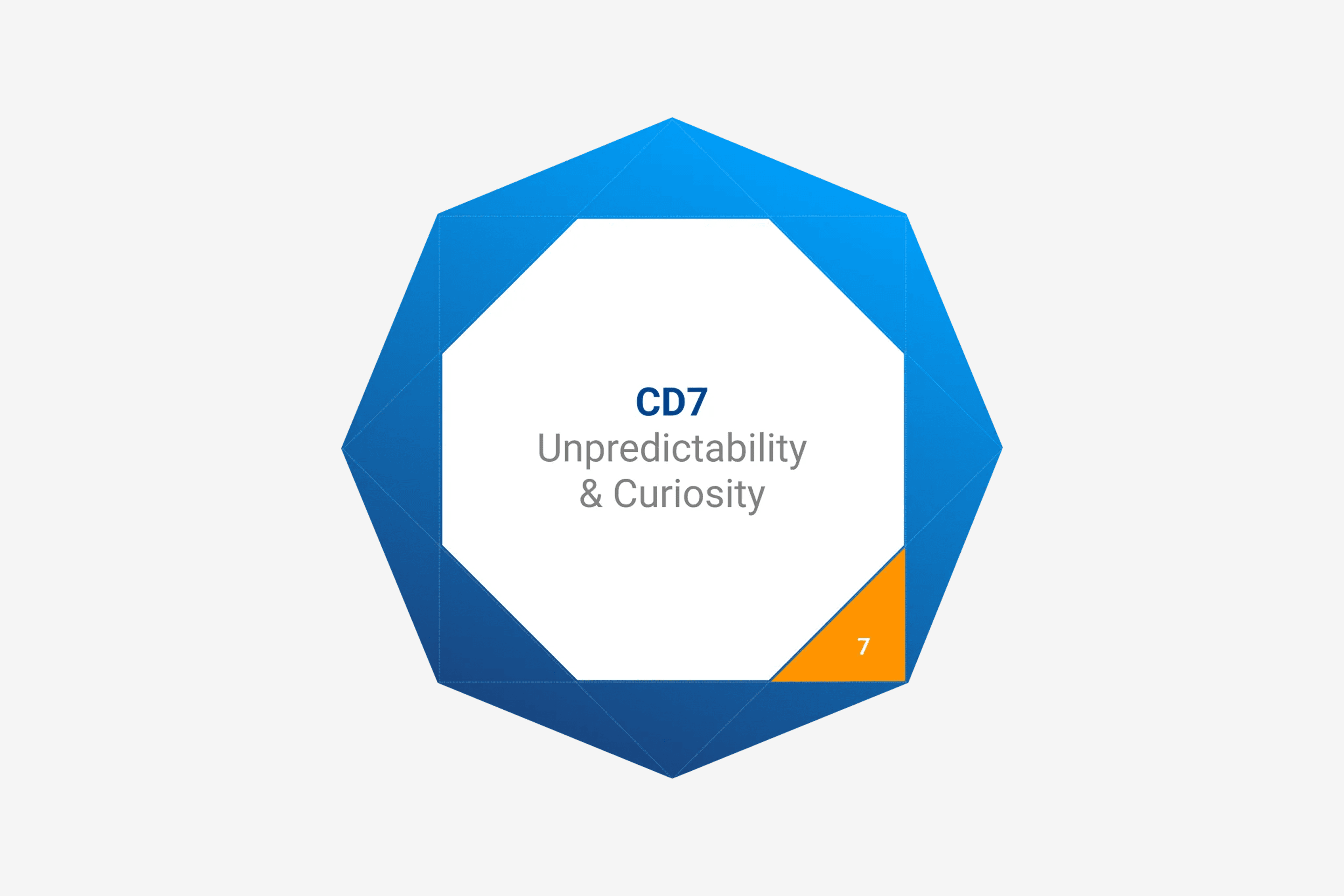
Reels are addictive because upon scrolling you don’t know what’s going to come next and that’s what keep you hooked.
My hypothesis was, using this same principle in showing random questions in a stream based on student’s preferences would definitely result in good engagement. The added benefit of this was, in between the stream (just like games), we can show advertisements of NST in various forms. Not only this, we would reward students for every question they solve and show them where they stand at All India level using leaderboard. I discussed this idea with PMs. PMs straightaway said yes. This became the core of the product. And voila! Our design journey started.
Started with Landing page
I started the design process with the landing page of product. Just like we have landing pages for our other growth products, the goal was to keep it short and simply explain the proposition of the product.
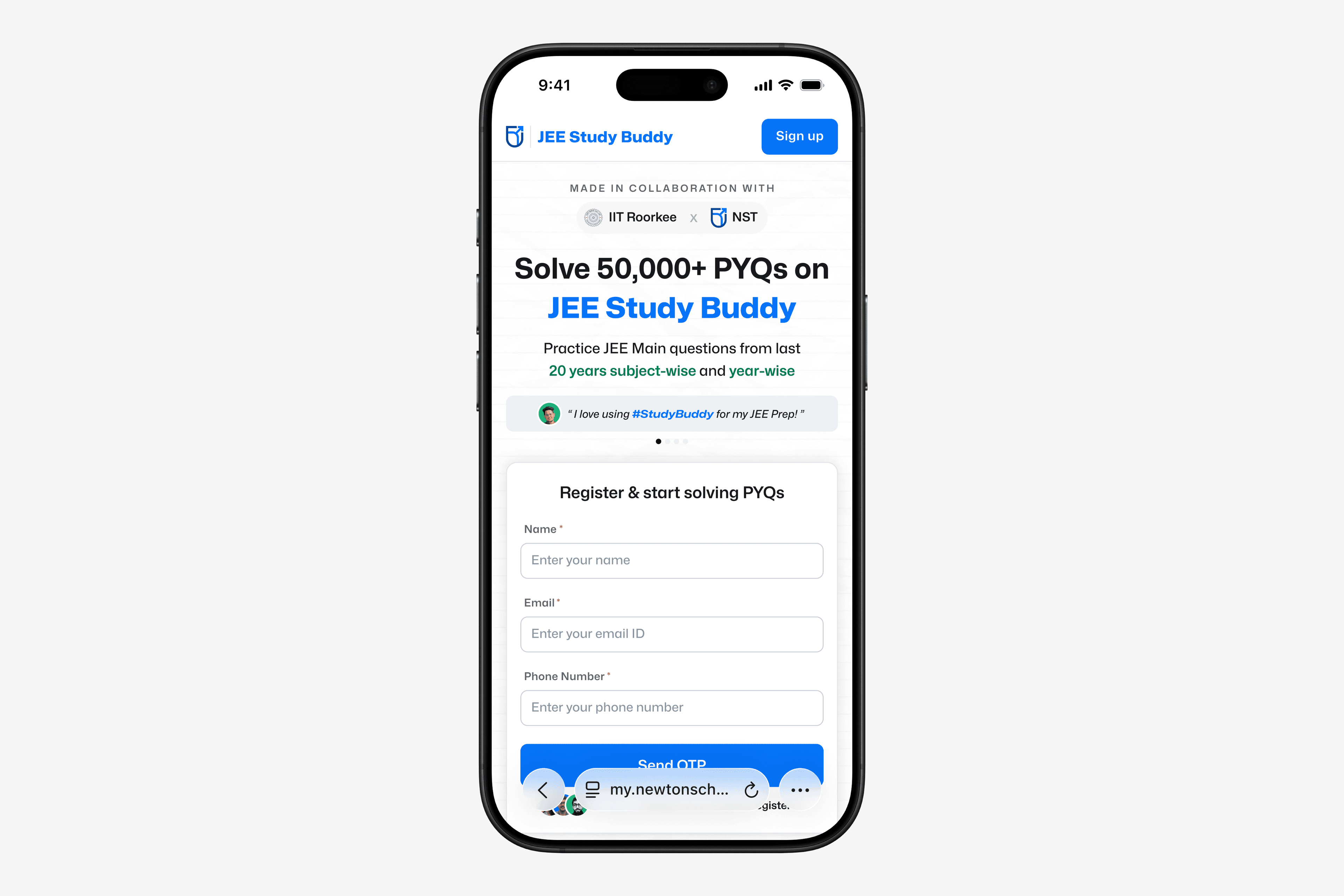
We added a bit of papery-touch to introduce a delight factor of like student solving PYQs from a physical book.
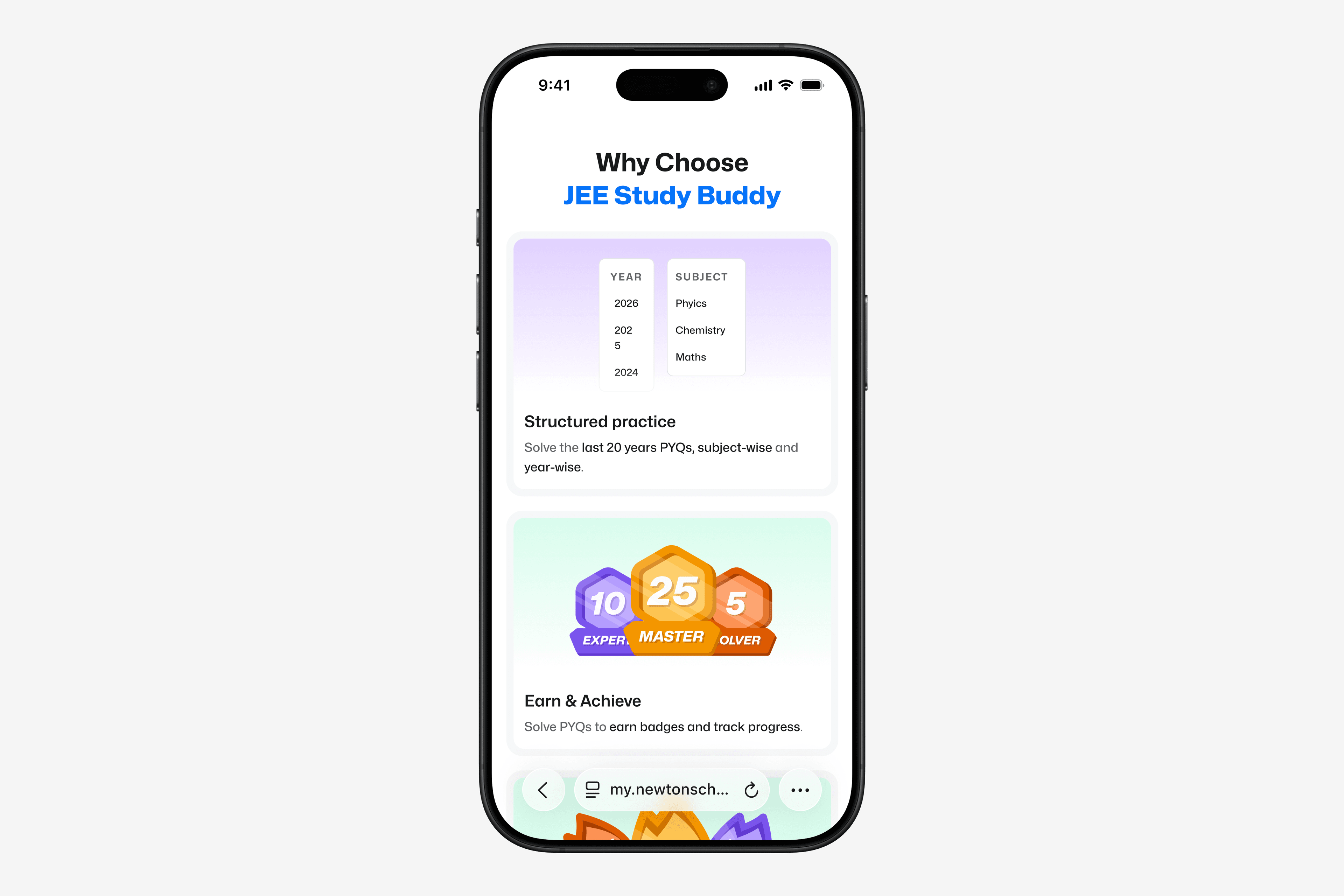
We have kept only these two section because we decided these were sufficient enough to convince students to start using the product. The rest was SEO content.
Homepage
Because our goal was to drive engagement, we brainstormed on how we can make it very easy for a student to start attempting previous year questions.
In first take, we decided to show previous year upfront. But what if a student wants to solve Qs of multiple previous years.
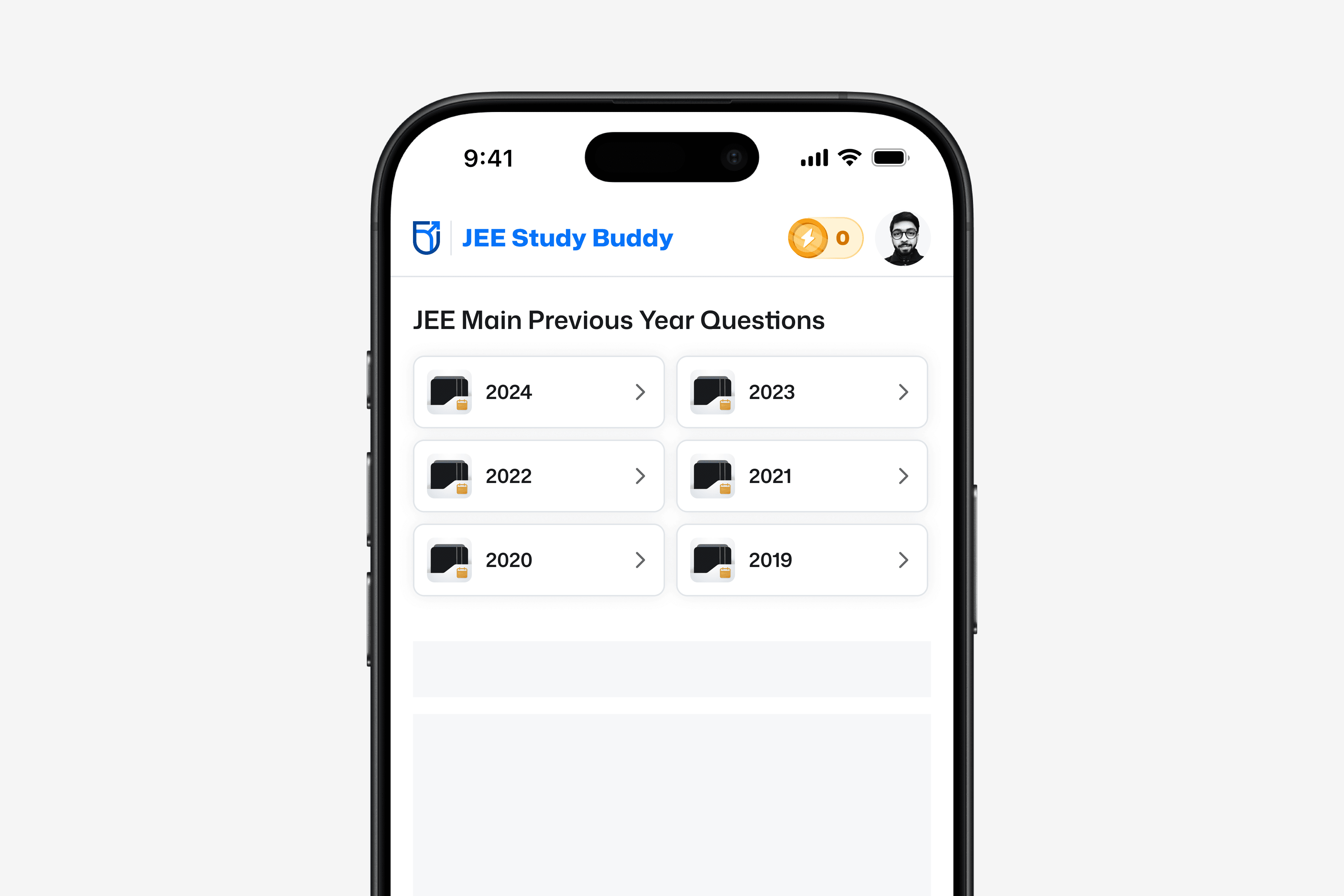
In second take, we decided to show subjects upfront. Again, what if a student wants to solve Qs of multiple subjects. This didn’t bothered us much because for every exam there are hardly 3-4 subjects.
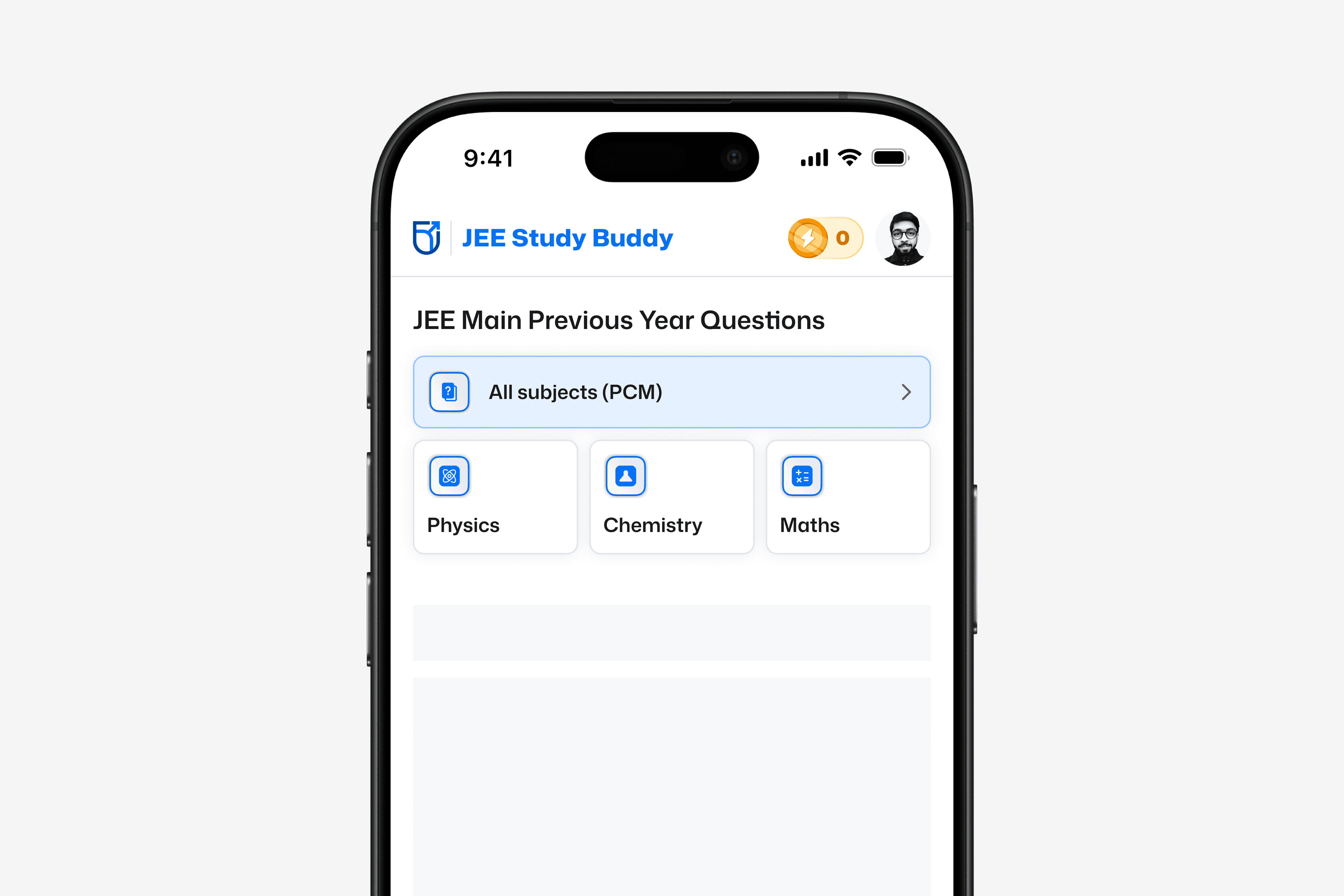
In final take, with the principle of unpredictability in kind, I thought can we somehow give a perception of product’s value to the student in the easiest way possible? Here, product’s value means a student solving a PYQ. With a bit of brainstorming, the idea of Question of The Day (QOTD) was born. We will show a random PYQ as QOTD upfront on the homepage.
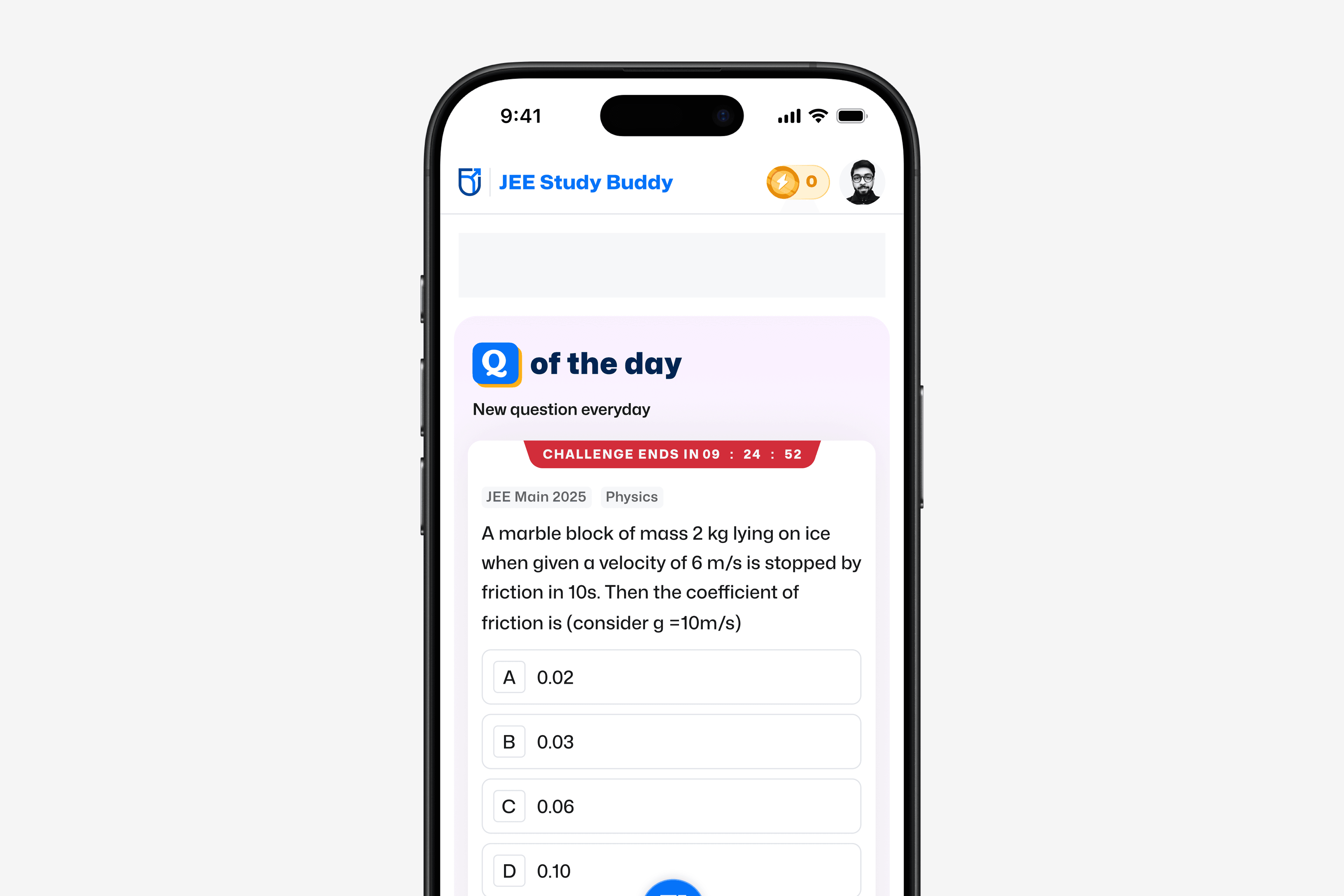
My hypothesis was, MCQ question which student has to select and submit (though some students do it unknowingly as well), we would be able to easily give product’s value to the student and intent to start solving PYQs will increase.
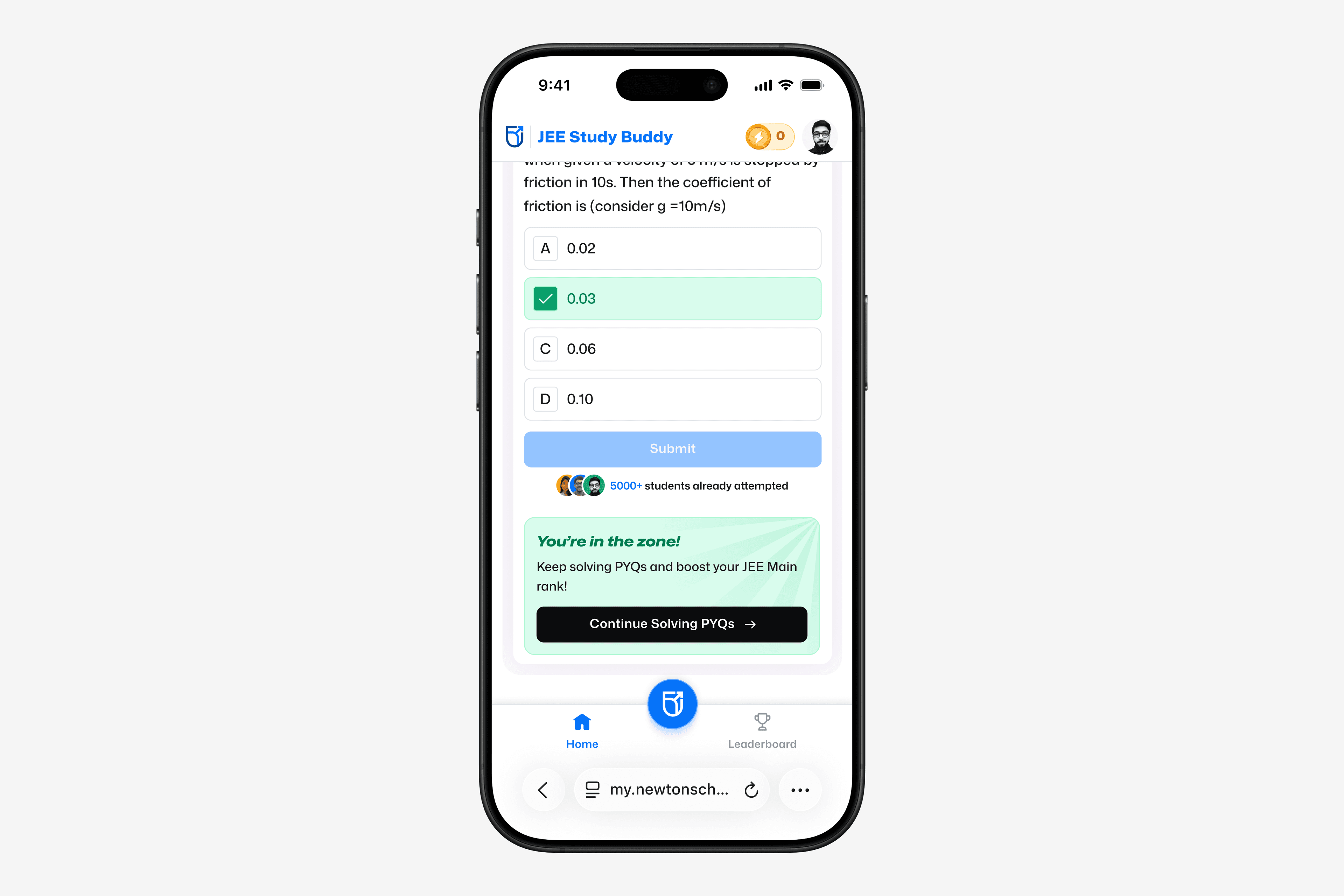
Apart from QOTD, anyways we have the top section of subjects where students can start solving PYQs as per their preferences.
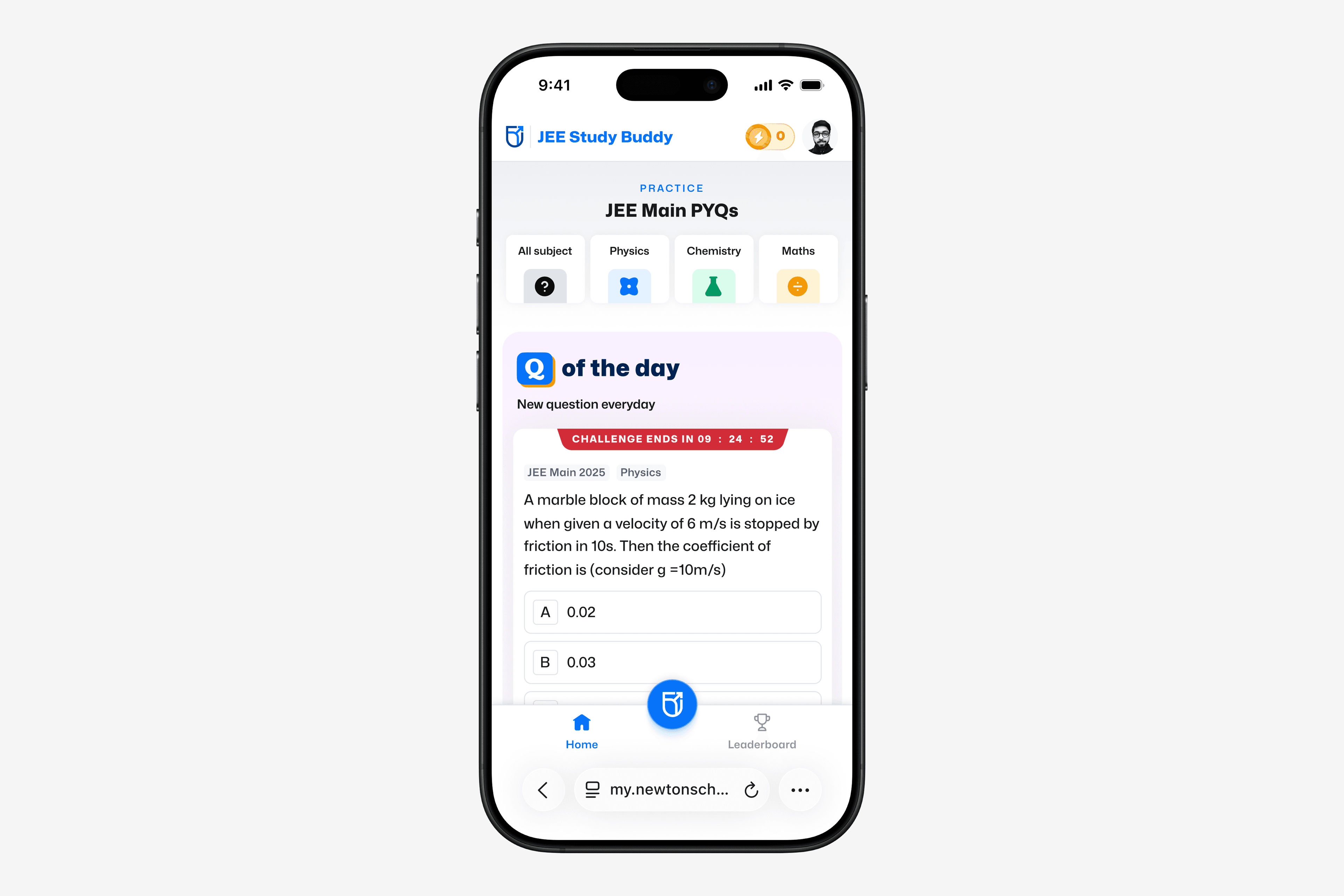
The core of the product
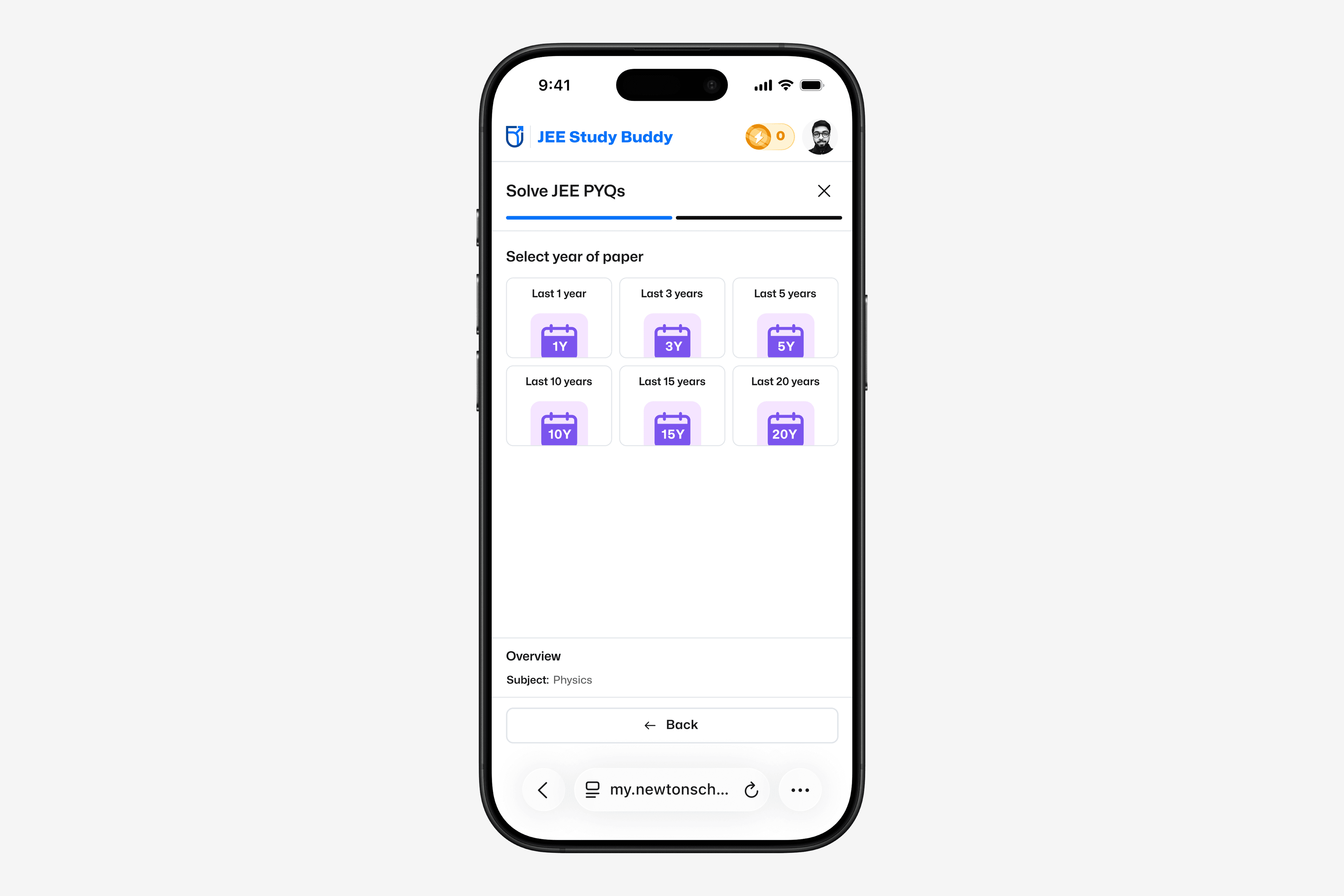
Let’s say the student clicks on any subject in top section of homepage, then we will ask about how many years they needs to solve questions for. Then, we will start the flow.
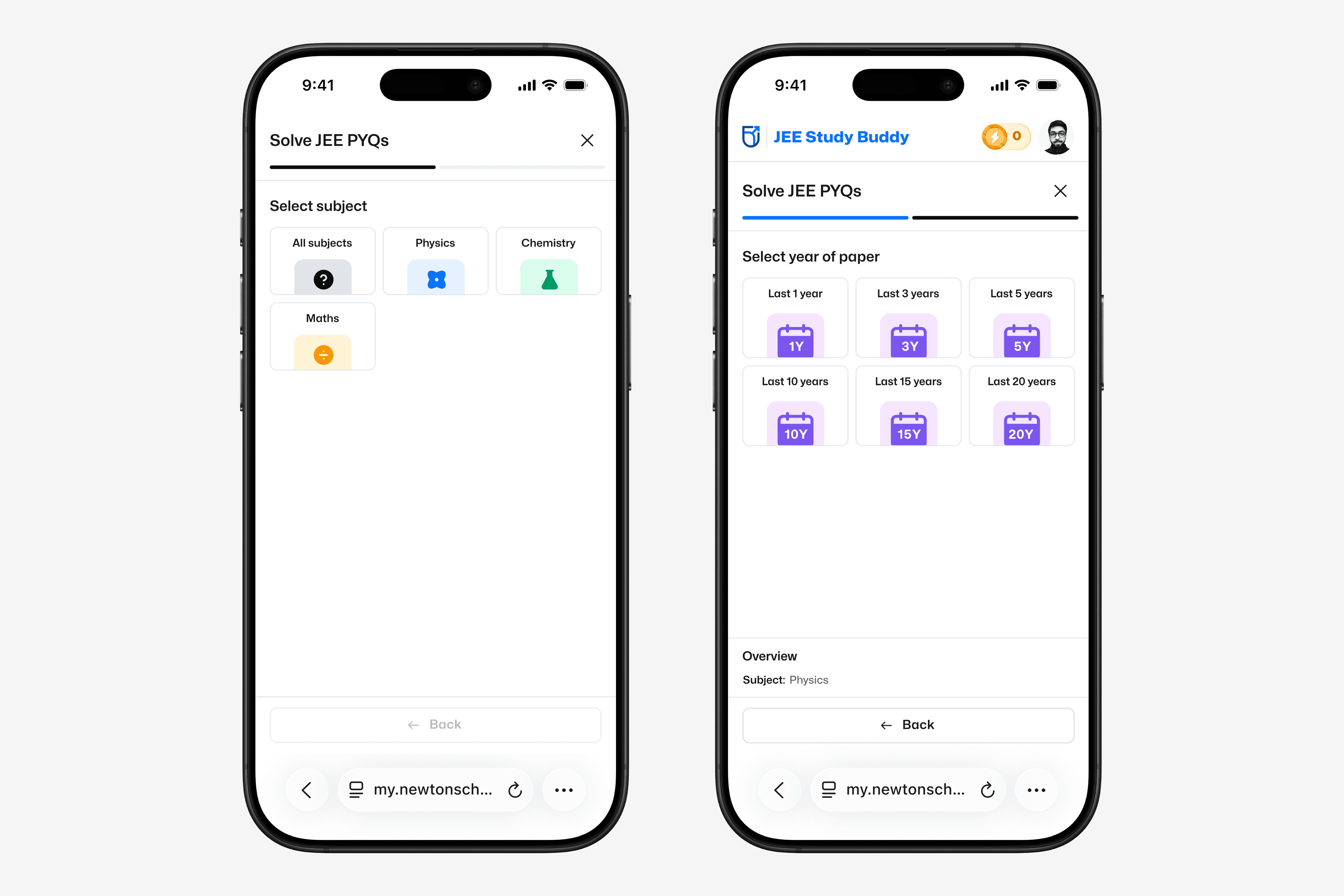
If say, the student starts the flow from QOTD, then we need to ask to both subject and years.
After selecting the options via above two paths, a student will enter the core flow of the product.
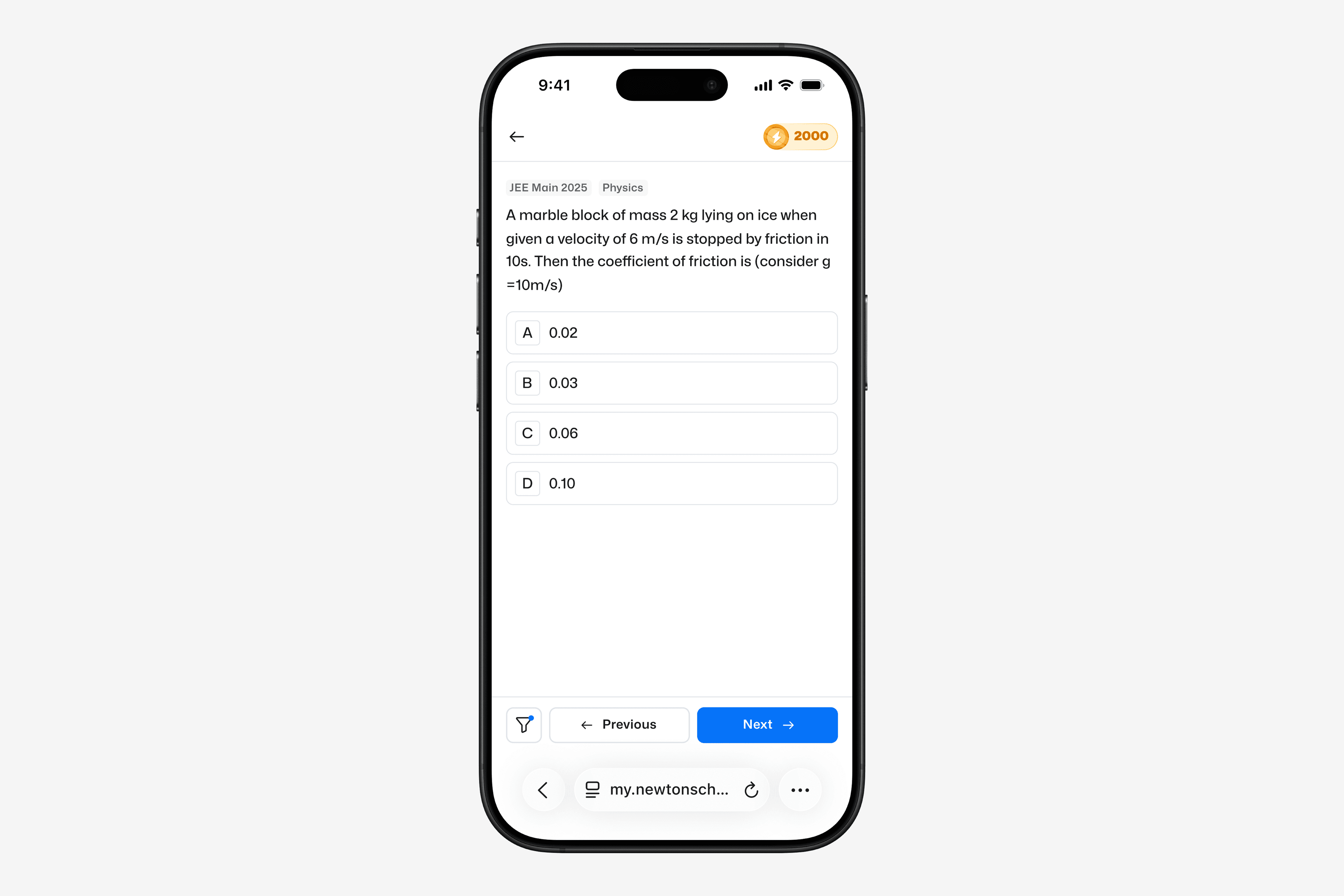
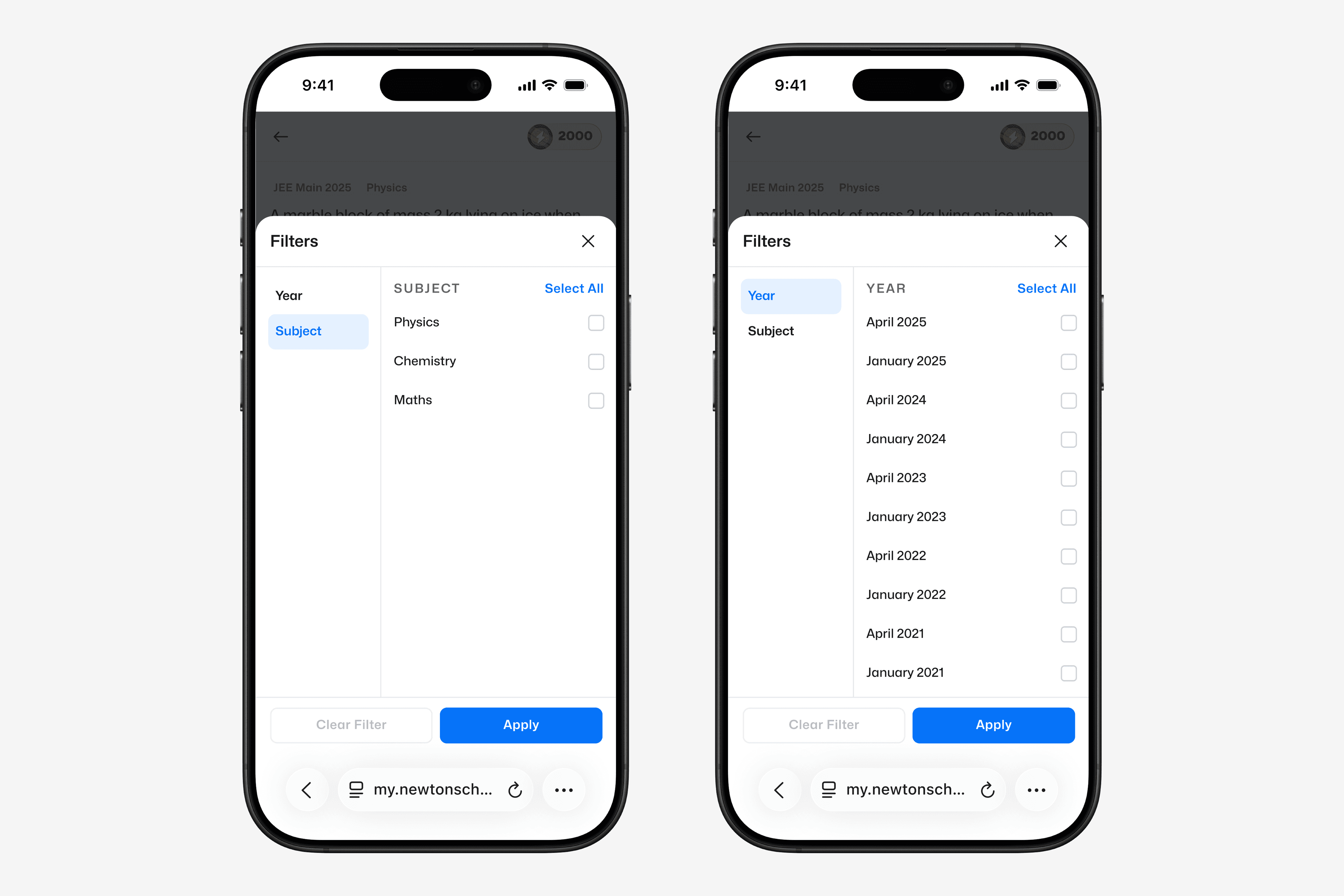
If a student want to change the subject and year, they can do so as well.
Rewarding students
To drive engagement, we leveraged our already-built points system, known as XP. We will give XP to students every time they solve a question correctly. Because we want to keep the platform very similar to real JEE, we will give 4 XP to students every time they solve a question correctly.
Showing where they stand
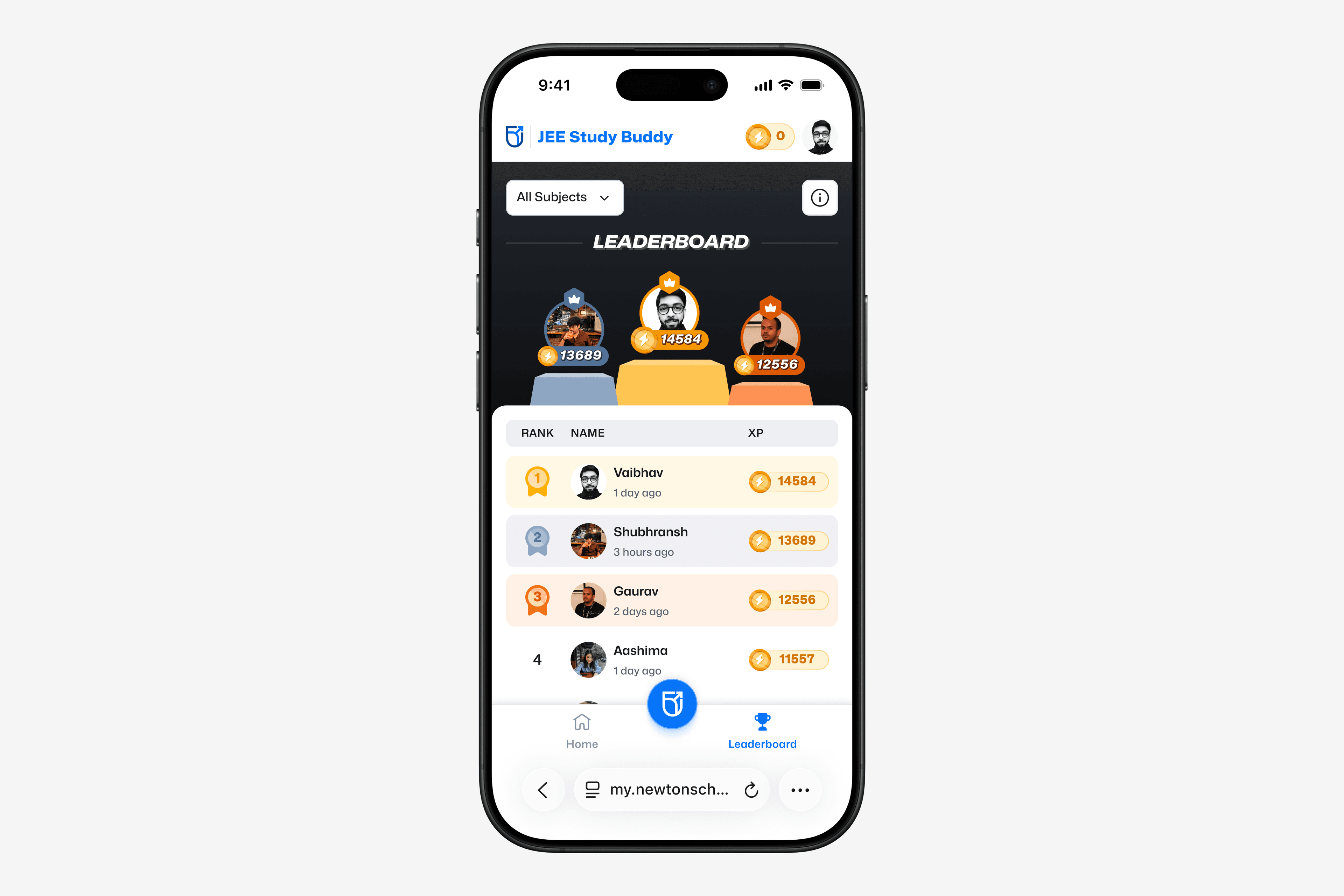
We will eventually use XP to show where they stand at All India level using our in-house built leaderboard.
JEE is all about accuracy
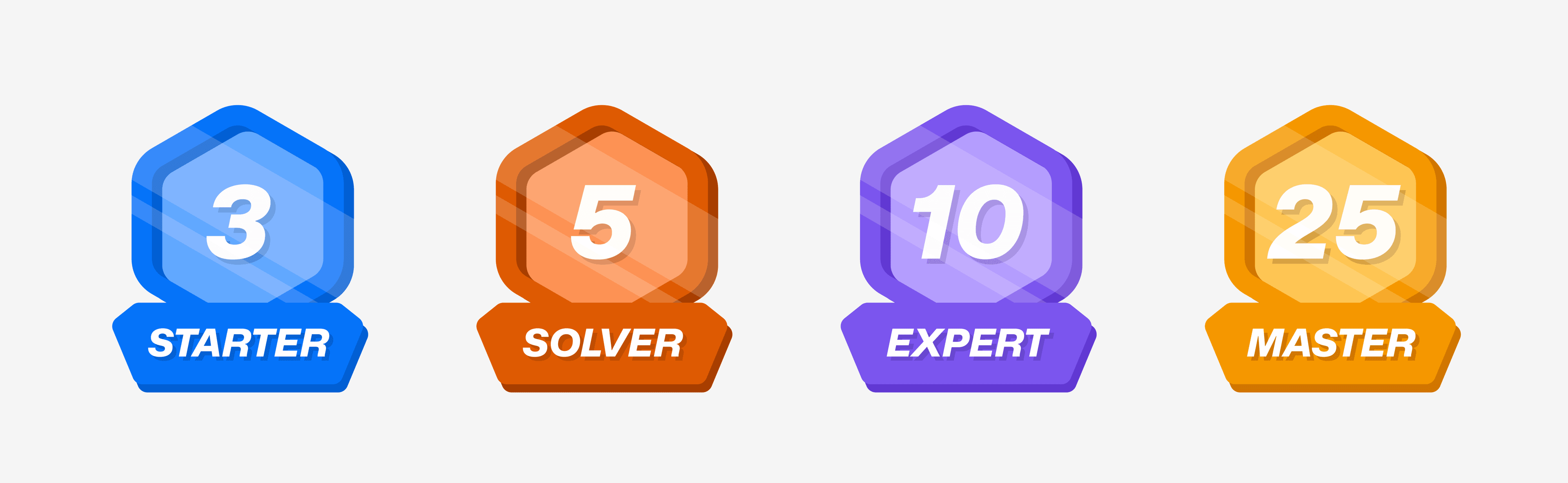
When we talked to students, most of them said, JEE is about accuracy. It simply means, how many correct Qs you can solve in given amount of time. This sparked the idea of introducing badges. I brainstormed with PMs and came up with a solution to give badges to students who solve questions correctly in a row. This not only helps them increase their accuracy but unlock a new lever for engagement.
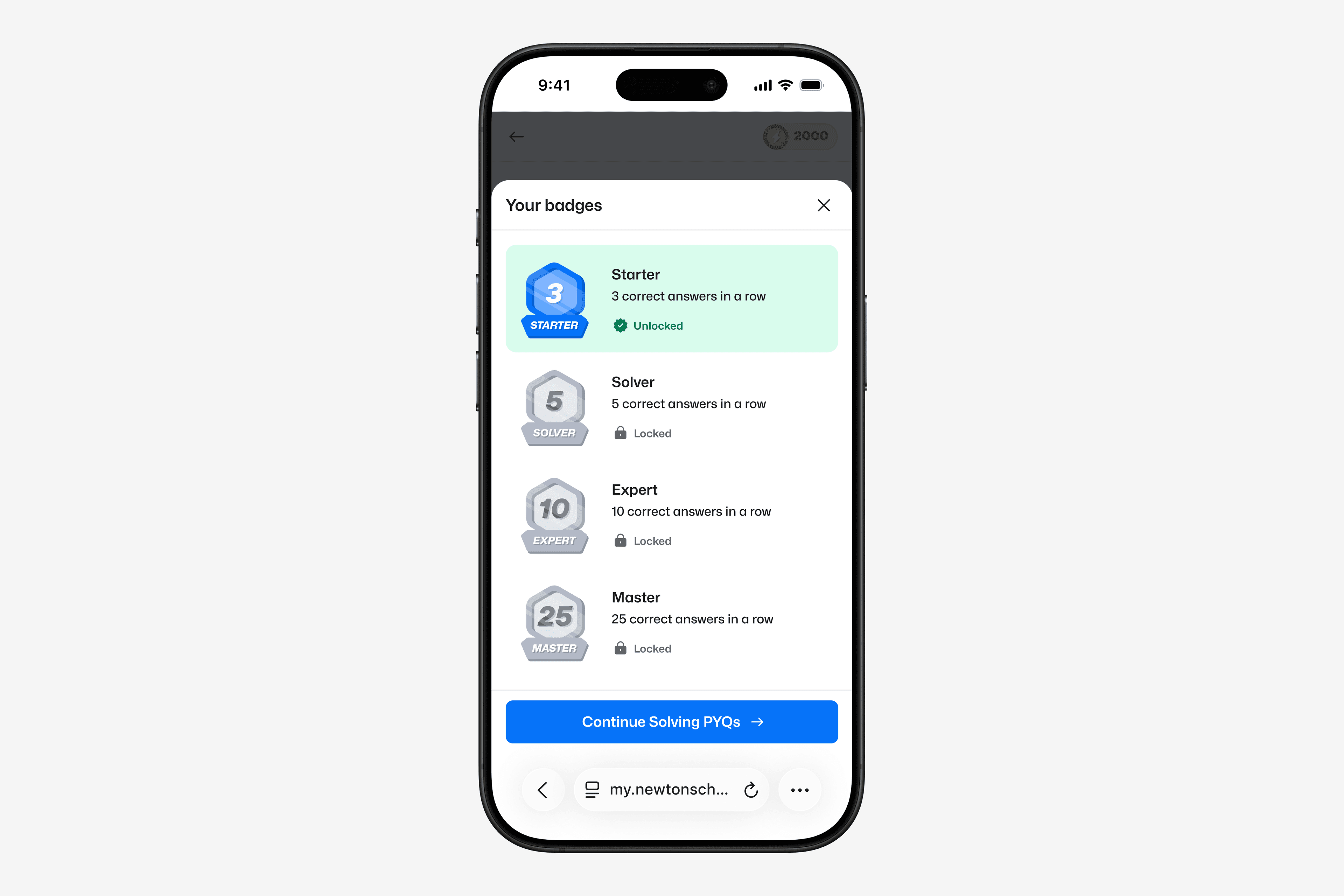
We had badges spanning across solving different count of correct Qs in a row.
To keep the engagement further going, we will show the list of future badges a student can unlock by engaging more with the platform.
But wait, what about brand awareness?
Isn’t it why we started building growth products, right? We leveraged the infinite stream of Qs to create brand awareness. Going back to Octalysis. You play games for a while, in-between encounter an ad, you either start to engage with the ad or you just wait for the timer to get over so that can continue playing the game. Now, the problem we had to solve was how we can make our ads engaging. Because a student obsessively seeks outcomes when it comes to taking admission in a college, we decided to showcase some really amazing achievements of current NST students as ads.
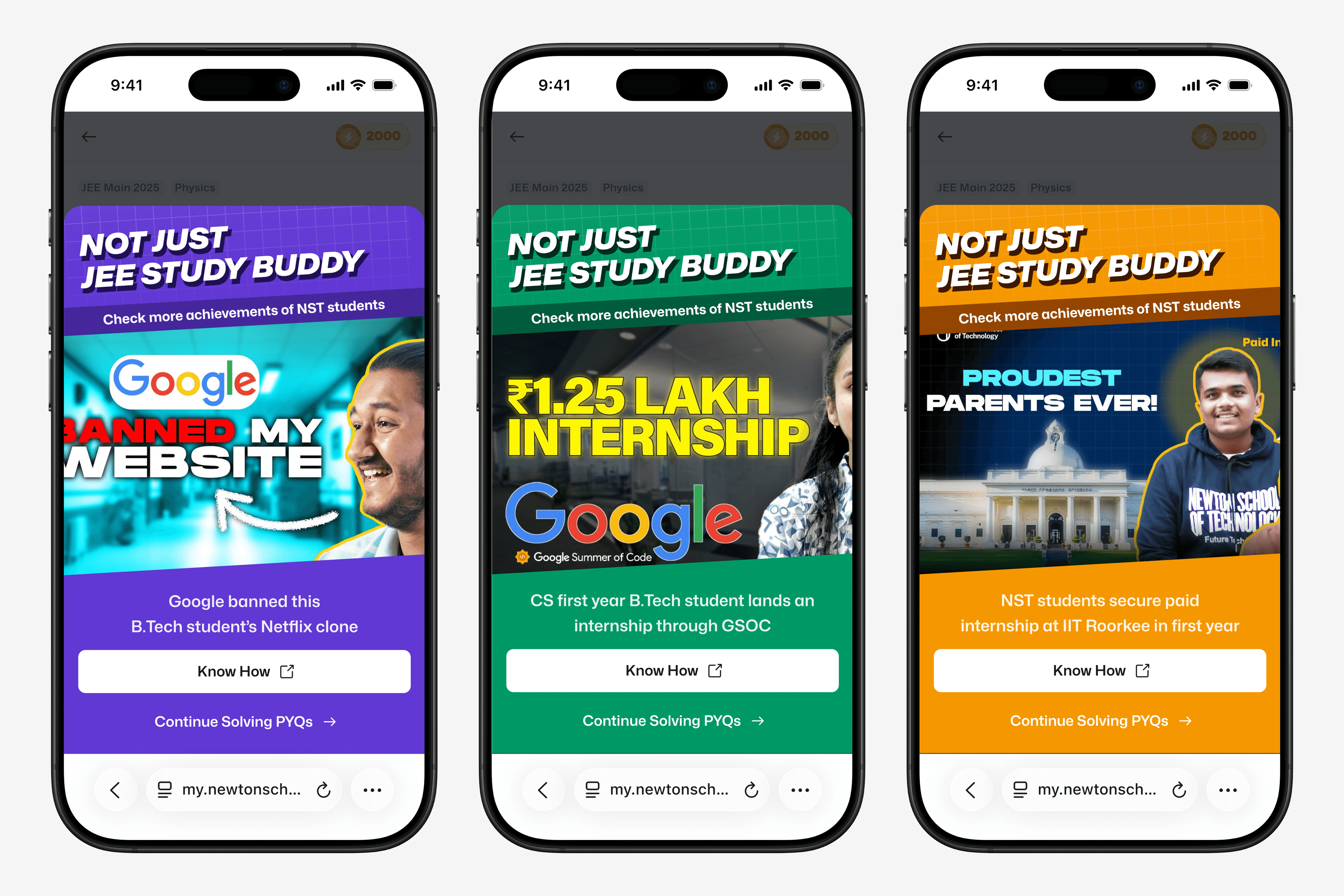
We had to be careful about positioning ads such that it doesn’t dilute the product’s core value.
Approach-1 (Ads can be skipped): When a student is in the stream solving questions and they click Next to navigate to next Qs, for the first time when stream starts we will show an ad after first 4 Qs and subsequently after every 8 Qs.
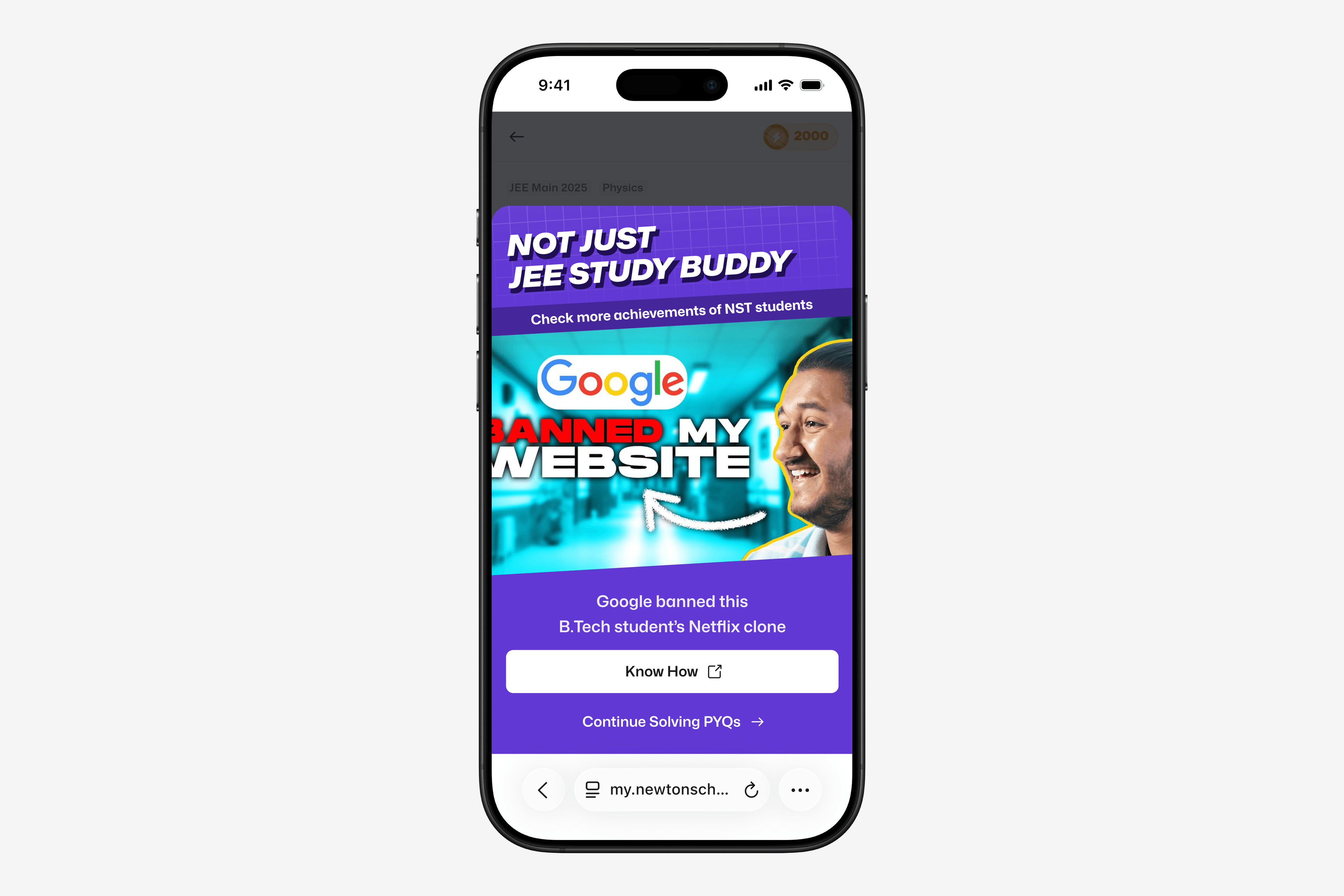
Approach-2 (Ads can't be skipped): Interestingly, if a student solves a question incorrectly and wants to see the solution, we placed an ad. We added a video ad of 30 seconds. Because the value proposition is so strong (which is viewing solution), our hypothesis was, these ads won’t seem that frustrating.
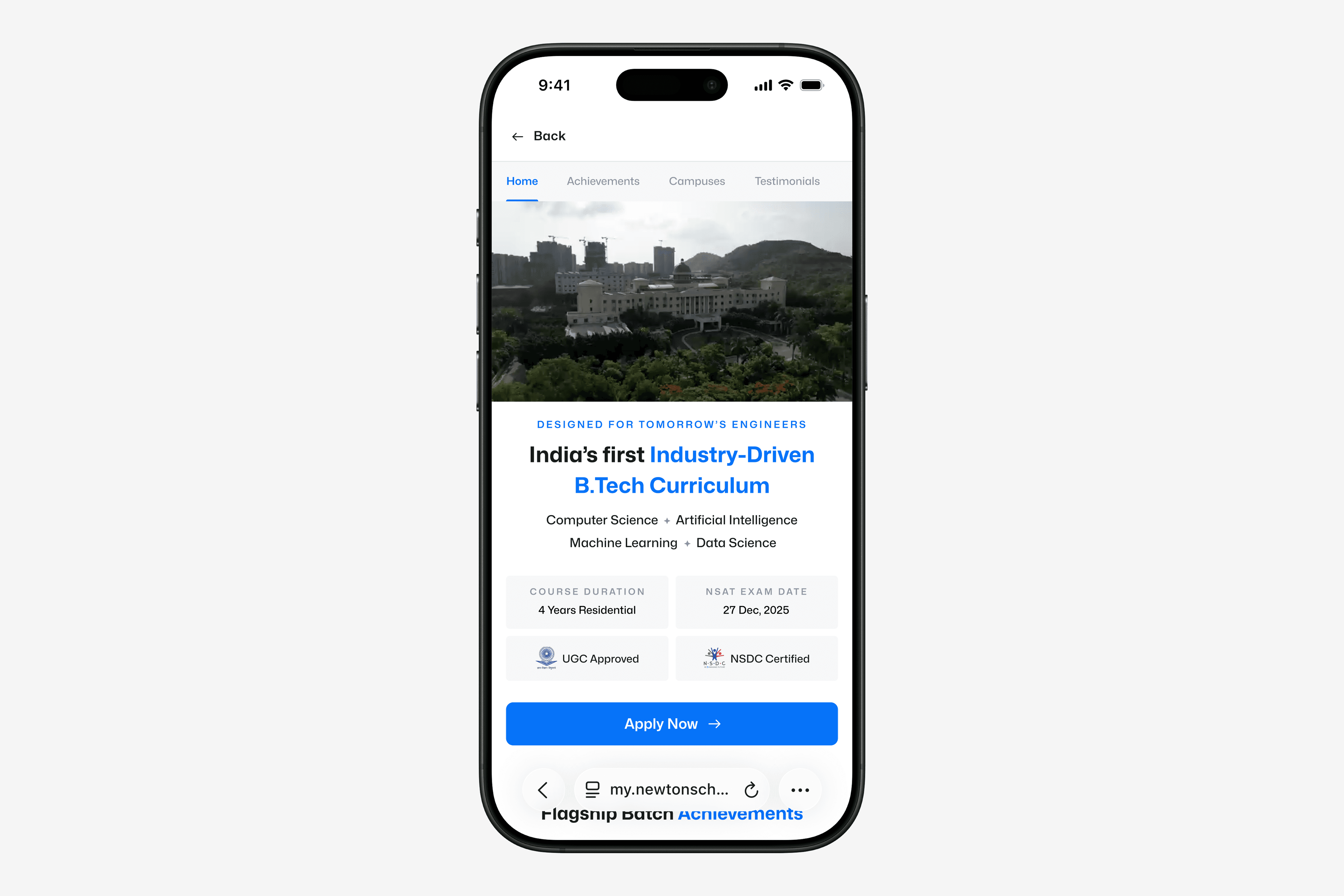
Not only this, we also added a dedicated page showing that this product JEE study buddy is built by 1st year NST students to build more credibility of our brand in students’ minds.
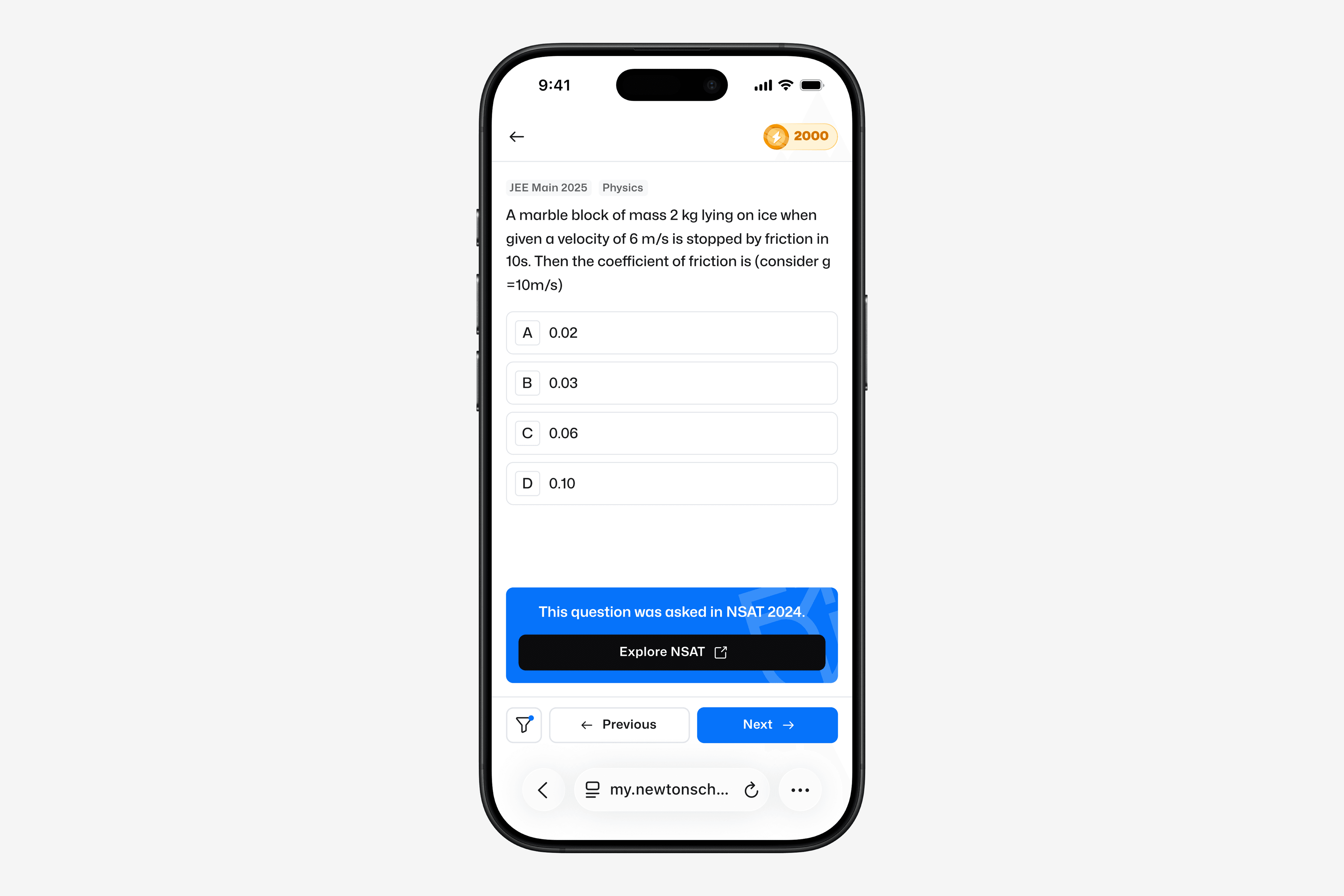
During the exam we also, added something like this was asked in Newton Scholastic Aptitude Test (NSAT) to build it’s awareness. It’s an entrance exam to take admission in any of the colleges of NST.
All set, let’s talk numbers
Please reach out on mail.
What’s next
Soon after the admission process was over, we started to actively work on this project again to understand what students says about the product. We did a bunch of student calls to understand what made them leave the product or retain and engage the product. We got a couple of insights like there’s no other exam than JEE, they can’t prepare chapter-wise, they can’t bookmark questions (similar to what they do in physical books) and a lot more. We saw a lot of potential in the product based on research and we started to build new features. But that’s for V2.
What did I learnt
The biggest learning was the power of speed. In a world where things are changing so quickly, the one who executes fast and learn will survive. I realised, now speed is like the new first-mover-advantage. It’s a moat these days, which many people look forward to (at least in startups).
Thanks to the team
A big thank you to Shubhransh Bhaskar and Gaurav Kumar for helping in designs, Mihir Sachdeva for extremely fast frontend development and Prashant Kumar for brainstorming with me. Thanks to Gaurav Kapatia (my manager) for being supportive in giving context of NST as much as possible.